<?xml version="1.0" encoding="UTF-8"?>
<feed xmlns="http://www.w3.org/2005/Atom"  xmlns:media="http://search.yahoo.com/mrss/" xmlns:dc="http://purl.org/dc/elements/1.1/" xmlns:itunes="http://www.itunes.com/dtds/podcast-1.0.dtd" xmlns:geo="http://www.w3.org/2003/01/geo/wgs84_pos#" xmlns:georss="http://www.georss.org/georss" xmlns:photo="http://www.pheed.com/pheed/">
 <title>The Strategist</title>
 <subtitle><![CDATA[Daily news and analysis for corporate &amp; political leaders]]></subtitle>
 <link rel="alternate" type="text/html" href="https://www.wmaker.net/thestrategist" />
 <link rel="self" type="text/xml" href="https://www.wmaker.net/thestrategist/xml/atom.xml" />
 <id>https://www.wmaker.net/thestrategist/</id>
 <updated>2026-11-25T14:27:22+01:00</updated>
 <generator uri="http://www.wmaker.net">Webzine Maker</generator>
  <icon>https://www.wmaker.net/thestrategist/favicon.ico</icon>
  <logo>https://www.wmaker.net/thestrategist/var/style/logo.jpg?v=1426090212</logo>
  <entry>
   <title>IE University : liquid learning as a new educational model for the digital age</title>
   <updated>2021-12-21T10:50:00+01:00</updated>
   <id>https://www.wmaker.net/thestrategist/IE-University-liquid-learning-as-a-new-educational-model-for-the-digital-age_a5676.html</id>
   <category term="Innovation &amp; Tools" />
   <photo:imgsrc>https://www.wmaker.net/thestrategist/photo/art/imagette/61143754-44626299.jpg</photo:imgsrc>
   <published>2021-12-21T10:29:00+01:00</published>
   <author><name>La Rédaction</name></author>
   <content type="html">
    <![CDATA[
Digital transformation is remaking the world. For many, this is experienced through an increasingly disrupted business environment. Experts tell us that rather than slowing down, change is only going to accelerate. This places immense pressure on the world of education to transform itself if it is to produce a workforce fit for the future.  Whether they call it digital, hybrid, or in the case of IE University, ‘liquid’ — higher education is experiencing a digital renaissance. With work and life changing, IE University’s Chief Learning Officer, Dr. Nick van Dam believes that, inevitably, the way we learn and educate must change too.     <div style="position:relative; text-align : center; padding-bottom: 1em;">
      <img src="https://www.wmaker.net/thestrategist/photo/art/default/61143754-44626299.jpg?v=1640080412" alt="IE University : liquid learning as a new educational model for the digital age" title="IE University : liquid learning as a new educational model for the digital age" />
     </div>
     <div>
      
     </div>
     <br style="clear:both;"/>
     <div><b>The digital age is well and truly here. So, how is this transformation presenting itself in higher education?</b></div>
     <div>
      As you no doubt know, the pandemic accelerated technological trends by almost a decade. From digitization, automation, sustainability, to energy transition — the world is a different place. Clearly, learning and education must evolve as well.&nbsp;We&nbsp;<a class="link" href="https://www.ie.edu/university">at IE University</a>  &nbsp;have already been engaged in online education for two decades, ever since our first International Executive MBA in 2001. But, there were&nbsp;$16 billion in venture capital invested in global education technologies in 2020 — 32 times the level seen in 2010. A great number many universities are attempting the shift to online education. <br />  &nbsp; <br />  Liquid learning, however, is IE University’s unique, evidence-based education method, helping students and professionals to acquire expertise, develop skills, and cultivate the mindsets needed for the jobs of the future. We believe education should be liquid: this encapsulates the flexibility and the fluidity demanded of us by the times.&nbsp;
     </div>
     <br style="clear:both;"/>
     <div><b>Where do hybrid approaches factor into this, and how do they help to achieve better learning outcomes?</b></div>
     <div>
      Our research has taught us that hybrid models are a delivery method, one crucial component among many. Multichannel learning must be used to optimize student experiences across different delivery methods. That could be on-site, online, synchronous, asynchronous, or all of these combined.&nbsp; <br />  &nbsp; <br />  Regardless of the delivery channel, it is crucial that learning is an active process, an applied process. Students learn best when they are collaborating; learning must be active and social for students to succeed. To point them towards current and future jobs, education must also be anchored in the context of real-world organizations, and society in general. As part of that,&nbsp;IE University stays closely in touch with many of the organizations that hire our students, ensuring that our bachelor and master programs are state of the art. We renew them annually. <br />  &nbsp; <br />  Finally, personalization is key, as it&nbsp;enables the support of students’ unique needs, personal growth, and aspirations. We are extremely committed to these ideas. Our experience of 20 years in online education, and the recent launch of the&nbsp;<a class="link" href="https://www.ie.edu/liquid-learning/center/">IE Center for Liquid Learning</a>  &nbsp;testifies to this commitment.
     </div>
     <br style="clear:both;"/>
     <div><b>How is the IE University Center for Liquid Learning going to impact students and educators?</b></div>
     <div>
      The objective of the IE University Center for Liquid Learning is to facilitate knowledge sharing, feature Liquid Learning experiences, and build community. The center portal grants access to profiles of faculty, learning scientist, and the academic leaders who are shaping the IE Liquid Learning method. Faculty from universities from around the world will gain insights on Liquid Learning through publications on our pedagogies, learning design, and research.&nbsp; <br />  &nbsp; <br />  Liquid Learning is enabled by sophisticated education technologies and tools that will be featured on the center page. We are also organizing free webinars and offering different education programs for faculty all around the world.&nbsp; <br />  &nbsp; <br />  We believe that the sharing of knowledge and best practices is part of our purpose, our role in society.&nbsp;The technology will, of course, continue to evolve.&nbsp;New concepts from the learning sciences provide fresh insights into emerging digital teaching methods, and these can always be used to advance the learning experience.&nbsp;Our commitment to new technology in combination with pedagogical science runs deep.
     </div>
     <br style="clear:both;"/>
     <div><b>How are educators to assimilate all the innovative education technologies and platforms entering the market in the coming years?</b></div>
     <div>
      Experimentation is key.&nbsp;IE University’s vision is to continue to advance its architecture of learning technologies, adopting a ‘plug and play’ approach. That will mean dynamically replacing existing platforms with new ones, whenever they support improved learning outcomes for our students.&nbsp;&nbsp;
     </div>
     <br style="clear:both;"/>
     <div><b>Technology is essential for digital transformation, but it is frequently an organization’s people that struggle with the changing context. How does this truth play out in the educational space? </b></div>
     <div>
      Absolutely. As I mentioned, a benefit of our background in online teaching was that our people had far less catching up to do than most. But it is true, in education, everything comes back to the quality of faculty. Excellence is not an end state, it is a continuous pursuit. <br />   <br />  The best educators, I believe, tap into two separate resources. The first is their own&nbsp;deep expertise, the sum of their research impact, the relevance of their ideas in leading journals and magazines, and their success as thought leaders in their domain.&nbsp; <br />  The second is their role as exceptional and dedicated teachers. Understanding how to design and deliver highly effective learning experiences, for different audiences, and knowing to how to integrate learning technologies inside and outside the classroom — requires a wealth of experience.&nbsp; <br />   <br />  Fusing these two aspects is the educator’s capacity to inspire students, to encourage intellectual curiosity while being an advisor and mentor.&nbsp;Achieving faculty excellence requires dedicated, ongoing faculty training. Educators need practice, while feedback from students and peer faculty members is essential.&nbsp;
     </div>
     <br style="clear:both;"/>
    ]]>
   </content>
   <link rel="alternate" href="https://www.wmaker.net/thestrategist/IE-University-liquid-learning-as-a-new-educational-model-for-the-digital-age_a5676.html" />
  </entry>
  <entry>
   <title>The challenges Covid-19 is posing to learning, teaching, and working in society</title>
   <updated>2020-11-04T15:11:00+01:00</updated>
   <id>https://www.wmaker.net/thestrategist/The-challenges-Covid-19-is-posing-to-learning-teaching-and-working-in-society_a4845.html</id>
   <category term="Management &amp; Strategy" />
   <photo:imgsrc>https://www.wmaker.net/thestrategist/photo/art/imagette/51170934-39340728.jpg</photo:imgsrc>
   <published>2020-11-04T14:57:00+01:00</published>
   <author><name>La Rédaction</name></author>
   <content type="html">
    <![CDATA[
At enlightED Virtual Edition 2020, leaders of higher education institutions discussed taking “a crash course into the future”     <div style="position:relative; text-align : center; padding-bottom: 1em;">
      <iframe width="560" height="315" src="https://www.youtube.com/embed/BSBpp8TmiJw" frameborder="0" allow="accelerometer; autoplay; clipboard-write; encrypted-media; gyroscope; picture-in-picture" allowfullscreen></iframe>     </div>
     <div>
      
     </div>
     <br style="clear:both;"/>
     <div style="position:relative; text-align : center; padding-bottom: 1em;">
      <img src="https://www.wmaker.net/thestrategist/photo/art/default/51170934-39340572.jpg?v=1604499852" alt="The challenges Covid-19 is posing to learning, teaching, and working in society" title="The challenges Covid-19 is posing to learning, teaching, and working in society" />
     </div>
     <div>
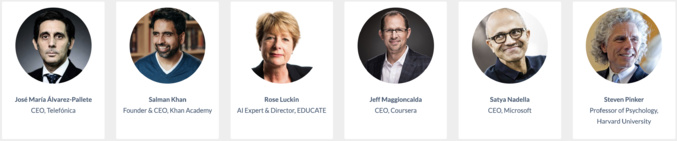
      <a class="link" href="https://www.enlighted.education/EN/enlighted">EnlightED Virtual Edition 2020</a>  brought together 90 renowned thinkers over a five-day online event to discuss the consequences of the Covid-19 pandemic on digital trends in higher education and the workplace. The third edition of the world conference, which was organized by IE University, Fundación Telefónica, Fundación Santillana and South Summit, hosted from Madrid between the 19<sup>th</sup> and 23<sup>rd</sup> of October and focused on the intersections between education, technology, and innovation. <br />  &nbsp; <br />  The conference brought together 30.000 participants from more than 20 countries and featured discussions from some big names, including Harvard University professor of psychology, Steven Pinker; essayist, researcher and mathematician, Nassim Nicholas Taleb; Salman Khan, the founder of the Khan Academy; Jeff Maggioncalda, the CEO of Coursera; Mariya Gabriele, the European Commissioner for Innovation, Research, Culture, Education and Youth, among many others. <br />  &nbsp; <br />  Some key takeaways were delivered during the “Beyond COVID-19: Europe and Higher Education” panel. Four heads of leading European universities came together to discuss their experiences overcoming the challenges imposed on course delivery due to the crisis. Speaking with presenter Cristina Manzano, they covered a lot of ground, revealing insights into the digital transformation of higher education, and calling for a European model of digital hybrid education founded in European enlightenment values.
     </div>
     <br style="clear:both;"/>
     <div><b>The consequences of Covid-19 on learning and teaching</b></div>
     <div>
      Many universities were forced to overhaul their degree programs to online formats amid the sweeping lockdowns that gripped Europe. Due to the unprecedented challenges imposed on faculty and professors, by the need to adapt curricula and course delivery methods for an online paradigm, a fundamental rethink of teaching was necessary. Each of the event panelists agreed that digital technology has incredible potential to enhance the learning process, but they also made interesting observations about the need to have in-presence interactions to cement learning experiences. <br />  &nbsp; <br />  Santiago Iñiguez, the president of IE University, an international institution based in Spain with students from 140 countries, explained that IE University benefitted from existing deep expertise in hybrid teaching.&nbsp; <br />  &nbsp; <br />  “We have been working for the past 20 years in hybrid formats […] and thus we were able to jump into hybrid formats during the confinement on the spot,” he said. IE University launched its first hybrid Masters 20 years ago and is recognized among the top institutions worldwide in online education. <br />  &nbsp; <br />  It can be very challenging running digital teaching environments. This is because virtual spaces demand that professors manage the delivery platform and the digital blackboard while keeping an eye on students, the president of IE University explained. For hybrid — digital and in-person — models, this means monitoring students onsite and those in online attendance simultaneously. “Already teaching is stressful, and if you add all those elements, it can be actually a very demanding task,” he said. <br />  &nbsp; <br />  According to Edeltraud Hanappi-Egger, rector of Vienna University of Economics and Business, simply switching original teaching concepts into the virtual world does not work. Her professors had to learn and develop new approaches on the job. <br />  &nbsp; <br />  “It’s not just about technological competences […] they really had to redesign their concepts,” she explained. <br />  &nbsp; <br />  Faculty also needed coaching, workshops, and community learning in order to meet the practical and conceptual challenges posed by online teaching methods — and in order to fully capitalize on the opportunities. Hanappi-Egger noted that it was much easier to switch to online formats in cohorts of students who already knew one another. This was because for first year students there is a greater need to form friendships and build informal learning groups before they are comfortable interacting through digital technologies. <br />  &nbsp; <br />  Faculty need to be trained for digital teaching technology, so that they can make the best possible learning experience for participants.&nbsp;Iñiguez highlighted that, in his opinion, digital tools themselves, while bringing education forward and being very powerful resources, cannot entirely replace face-to-face teaching. He referred to studies on undergraduates and postgraduates, which reveal that they miss being on campus and interacting. He believed that this is only natural. <br />  &nbsp; <br />  “Education is an embodied activity. When we are small children, we start learning not just by listening and seeing things, but even by touching: so the use of the senses is vital for the learning process,” he said. These kinds of consideration have been going into&nbsp;<a class="link" href="https://www.ie.edu/liquid-learning/">IE University´s Liquid Learning</a>  &nbsp;model for the last few months, a program charting new ground in digital hybrid pedagogy. “Our new education model allows students to attend class in person or online with equal immersive experience and academic excellence. This methodology provides flexibility for students and reinforce active and personalized learning that focuses on solving real world problems”, Iñiguez de Onzoño added.
     </div>
     <br style="clear:both;"/>
     <div><b>A hybrid model is the answer</b></div>
     <div>
      The other panellists were in agreement, maintaining that the future of higher education is a hybrid model, and not the all-online offer at times deployed during the Covid-19 crisis. <br />  &nbsp; <br />  “Because of the pandemic, each of us were forced to attend a crash course into the future,” explained&nbsp;Andrea Prencipe, rector of Luiss University in Rome.&nbsp; <br />  &nbsp; <br />  Of his faculty members, some were already familiar with digital learning, but now the entire faculty has had the experience and can use digital technologies effectively. Luiss University has now embraced a hybrid model that offers more spaces and on campus presence for students in their first year, and then overall for the other students, a 50-50 online and in-presence model. The in-presence interaction is needed to make sure that learning takes place, Prencipe explained. <br />  &nbsp; <br />  “We shouldn’t forget that learning is a social process and, in fact, […] a&nbsp;<em>socialising</em>&nbsp;process,” the rector added.&nbsp;“It can be augmented by digital technologies […] [but] it cannot be&nbsp;<em>substituted</em>&nbsp;by them.” <br />  &nbsp; <br />  At Maastricht University in The Netherlands, major lectures have moved online, along with all larger classes; but smaller groups, those with real social interactions, these are organised on campus, explained the university’s president, Martin Paul. <br />  &nbsp; <br />  “In my view, this is the model,” he argued. “I don’t think a full-time digital virtual environment for the whole degree programme is going to be viable to replace what we have done in the past.” <br />  &nbsp; <br />  &nbsp;“If there is a lockdown, you have to go this way,” he said. “[But] if we can avoid that, I think the future is blended classroom-based hybrid education.” <br />  &nbsp;
     </div>
     <br style="clear:both;"/>
     <div><b>A uniquely European model for future higher education</b></div>
     <div>
      Together, the panelists evoked a picture of a future that is opening up before Europe, partly as a consequence of the pandemic, partly as a consequence of its particular tradition and character. When asked about the possibility of increased competition, even market concentration, caused by digital technologies entering higher education, the panelists had a positive message.&nbsp;"The response from European universities has been in face of this crisis much more proactive and quick than the reaction of American universities" said Iñiguez. <br />  &nbsp; <br />  “There is one big strength of Europe […] a kind of innovative capacity due to the diversity that we have,” suggested Vienna University’s Edeltraud Hanappi-Egger. <br />  &nbsp; <br />  While she acknowledged that European universities are in a global commercial competition, she saw a clear chance of a specific European model of higher education, which would create “a value-driven society of solidarity based on education.” <br />  &nbsp; <br />  Maastricht University’s&nbsp;Martin Paul sounded a similarly optimistic tone. <br />  &nbsp; <br />  “The modern university is a European invention, and so I think we should build the future on our tradition,” he said. “Our strengths and our future must be that we are non-elitist.”
     </div>
     <br style="clear:both;"/>
     <div style="position:relative; text-align : center; padding-bottom: 1em;">
      <img src="https://www.wmaker.net/thestrategist/photo/art/default/51170934-39340728.jpg?v=1604500054" alt="The challenges Covid-19 is posing to learning, teaching, and working in society" title="The challenges Covid-19 is posing to learning, teaching, and working in society" />
     </div>
     <div>
      
     </div>
     <br style="clear:both;"/>
    ]]>
   </content>
   <link rel="alternate" href="https://www.wmaker.net/thestrategist/The-challenges-Covid-19-is-posing-to-learning-teaching-and-working-in-society_a4845.html" />
  </entry>
</feed>